Why Clear Routes Make a Room Easier to Read
Clear routes make a room easier to read by showing where people can move, pause and turn without hesitation or awkward detours.
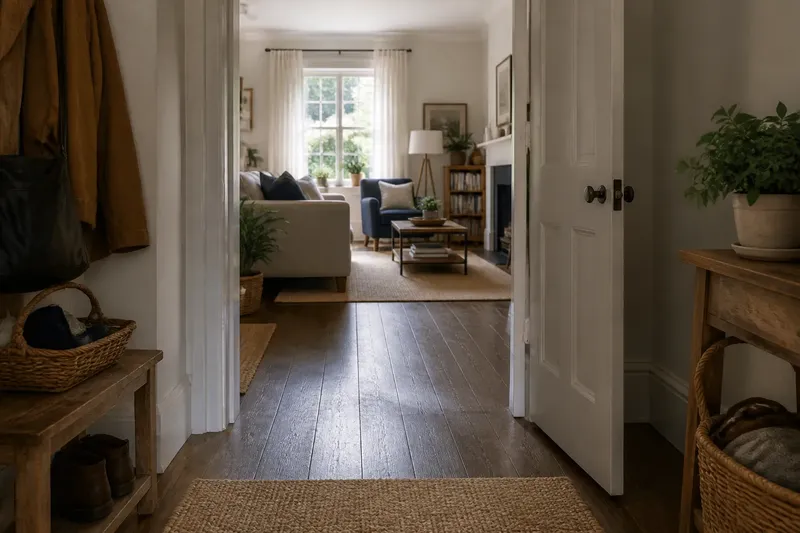
The common mistake in a busy room is to judge it from the doorway and assume that a clear patch of floor means a clear route. A chair pulled back, a basket beside the sofa or a door left half open can turn that apparent path into a series of small hesitations. Clear routes make a room easier to read because they show, at a glance, where a person can go next.
This is less about making a room look sparse than noticing how its ordinary paths work. Watch where people enter, turn, pause and leave. Their movement often reveals the room’s logic more plainly than its furniture arrangement does.
A route begins before the first step
Stand just outside a room and look in. Your eye will usually pick up a doorway, an opening between pieces of furniture, or a brighter patch beyond. These visual cues suggest a direction before anyone starts walking. If a large chair blocks the view through the room, people may not know whether the route continues behind it or ends at the chair.
Notice the sequence of openings, not just the amount of floor. A path from a hall into a sitting room may lead around a sofa and towards a window. If the sofa’s back faces the doorway, it can still define the space, but a visible gap beside it tells a newcomer where to pass. The room becomes easier to understand when the next part of the route is legible from the current one.
Think of a route as a sentence: each opening is a word that helps explain what comes next. A sudden obstruction is like a missing word. It does not make the room unusable, but it asks the person moving through it to stop and work out the meaning.
Door swings quietly redraw the floor
A door needs room to move, and its open position can change the shape of a route. In a small bedroom, an inward-opening door might cover the space where someone naturally steps aside to let another person pass. In a kitchen, a cupboard door left open can briefly interrupt a path between the worktop and the table.
Observe the room with doors in their usual positions. Does the entry door rest against a wall, or does it sit across the visible opening? Does a cupboard door remain open while someone is putting away dishes? These everyday states matter more than a tidy, still-room view. The useful question is not simply whether a door can open, but whether its open position leaves a clear way through.
If a door repeatedly interrupts the route, first notice the habit around it. Perhaps people leave it ajar because the latch catches, or because a room is used in a way that keeps it open. The observation is enough to identify the pinch point; any change to the door or its fittings depends on the home and the relevant instructions.
Furniture edges show where to turn
People tend to follow the edges of large furniture. A sofa, dining table or bed gives the eye a stable boundary, and the space beside that boundary can read as a route. A small object placed at the turning point may break that cue. A footstool, magazine stack or plant pot can make a formerly obvious passage look narrower or uncertain.
Look for places where someone changes direction. Beside a sofa arm, at the end of a dining table, or between a bed and a wardrobe, a turn needs to be visible as well as physically possible. If the furniture’s outline points one way while the open floor suggests another, people may pause to choose.
Imagine a sitting room where the usual path runs from the hall past the sofa towards a window. A low basket sits at the sofa’s outer corner, exactly where visitors turn. If the household moves the basket beside the bookcase, the corner becomes easier to read and people can continue without weaving around it. The point is not to remove every object, but to notice whether an object occupies a decision point.
What should you watch during ordinary use?
Where do people slow down?
Watch for a slight pause, a sideways turn or a hand reaching out to steady a person against furniture. These small adjustments can signal that the route is visually unclear or awkward to follow. Notice the exact spot rather than blaming the room as a whole.
Do people take different routes at different times?
A dining room may have a simple path when the table is clear and a different one during a meal. A bedroom route can shift when a drawer is open or laundry is waiting to be put away. Observe the room in the states it commonly occupies, not only when everything is in place.
Can someone see where the route leads?
From the entrance, check whether the next opening is visible or hidden behind a tall chair, screen or cabinet. A route that disappears from view can feel uncertain even when it remains physically open. A small change in viewpoint may clarify whether the obstruction is visual, practical or both.
Where do people pause by choice?
Not every stop is a blockage. Someone may pause near a window to look outside, beside a shelf to choose a book, or by the table to speak with another person. Distinguish these useful pauses from places where people stop because they cannot tell how to pass.
Light and contrast help the eye follow a path
Light can make an opening more noticeable. A clear route that leads towards a window may be easy to understand, while a passage between dark furniture and a dim corner can seem to end abruptly. Notice the room at the times it is used: daylight shifts, lamps are switched on, and shadows can alter the apparent boundaries.
Contrast matters too. A pale rug against a dark floor may draw attention to a route, while a rug that blends into the flooring may make its edge harder to see. Neither arrangement is automatically better. What matters is whether the floor’s changes help people recognise where to step and where a furniture edge begins.
Keep this observation separate from major changes to lighting or wiring. Simply note where the route becomes harder to see and whether a lamp already in the room illuminates that area when needed. A clear path should make sense in ordinary light, not only at the brightest moment of the day.
Clutter has a different effect at a crossing
A book on a side table and a parcel beside the entry may occupy similar amounts of space, yet their effect depends on position. An object near a crossing, turn or doorway can interrupt the line of movement. The same object against a wall, outside the route, may barely register.
Try observing the floor as people use the room rather than scanning for untidiness. A pair of shoes may be easy to step around when entering, but awkward when someone carries a tray in the opposite direction. A shopping bag may be harmless in a corner until it obscures the gap between two chairs. Location gives the object its meaning.
When an obstruction appears repeatedly, ask whether it belongs there or has simply landed at a convenient stopping place. A low tray by the door might collect keys without occupying the route; a bag left in the narrowest passage might be better placed elsewhere. These are small household decisions guided by the path, not a demand for an empty room.
Read the room in more than one direction
Walk the usual route both ways, if the space allows. Coming in with empty hands can feel straightforward; leaving with a laundry basket or carrying plates can make the same turn less clear. You do not need to stage a test. Simply notice how ordinary tasks change the way a person holds their body and chooses a path.
Also look from seated height. A low table can disappear behind the edge of a sofa when viewed from the doorway, then become prominent when someone stands up. A chair placed neatly beside a wall may still project into the path once it is pulled out. The room has several useful viewpoints, and a route that reads well from one may be confusing from another.
Keep the central question simple: can someone tell where to move next without having to negotiate an unexpected obstacle? Clear routes make a room easier to read when openings remain visible, turns make sense and everyday objects stay out of the places people need to cross. That is a helpful thing to notice before deciding whether anything needs to move at all.