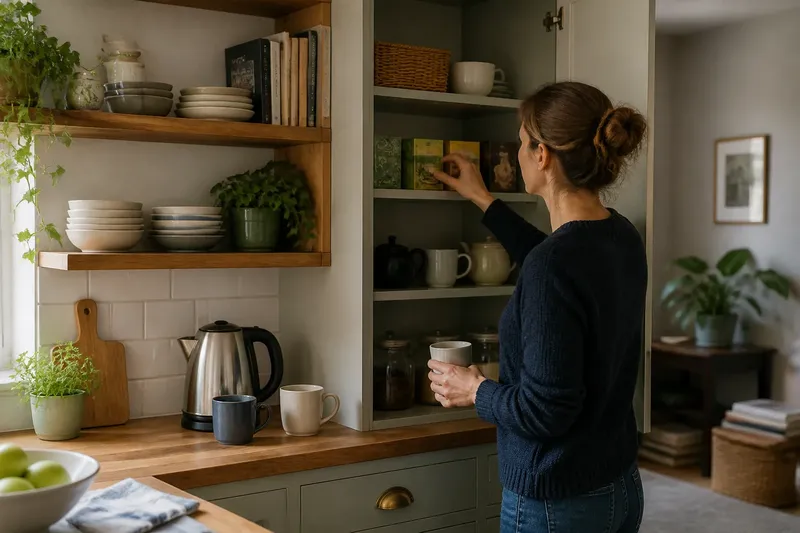
The Spare-Storage Trap: When Keeping Everything Gets in the Way
The spare-storage trap turns cupboards into holding bays. Learn to judge stored belongings by use and meaning, so useful space stays available.
The most common spare-storage mistake is keeping an item simply because a cupboard can hold it. The spare-storage trap turns a useful cupboard into a holding bay, and the cost is paid each time you have to move three forgotten things to reach the one you need. A box of mismatched glasses may be harmless on its own; a collection of boxes no one can name makes storage harder to use.
That does not mean a well-kept home must be spare or bare. A chipped mug can matter because it belonged to someone you love. A tin of spare buttons may be useful if you mend clothes. The question is whether an object earns the space it takes through practical use, genuine meaning, or both.
How the spare-storage trap took hold
Imagine an invented situation: Mara has inherited a narrow cupboard in the hall of her rented terrace house. It contains a folded tablecloth, spare light shades, old school papers, a box of cables and several kitchen things she does not recognise. When she needs the vacuum cleaner’s attachments, she has to shift the boxes first. She keeps putting the job off because nothing looks like an obvious candidate for removal.
The cupboard feels full, but its deeper problem is uncertainty. Mara cannot tell which things are useful, which are keepsakes and which are merely waiting for a decision. A shelf is like a coat pocket: it can hold a useful object, but filling it with things you might someday need makes the useful one harder to find.
Instead of emptying the cupboard into a pile and making a hurried decision about every object, Mara gives each item a fair hearing. She asks what job it does, when she last used it, whether something else already does that job, and whether its meaning is worth preserving. She also notices how easy it is to retrieve and put away. Those are practical questions, not a test of whether she is a tidy person.
Decide what earns its place
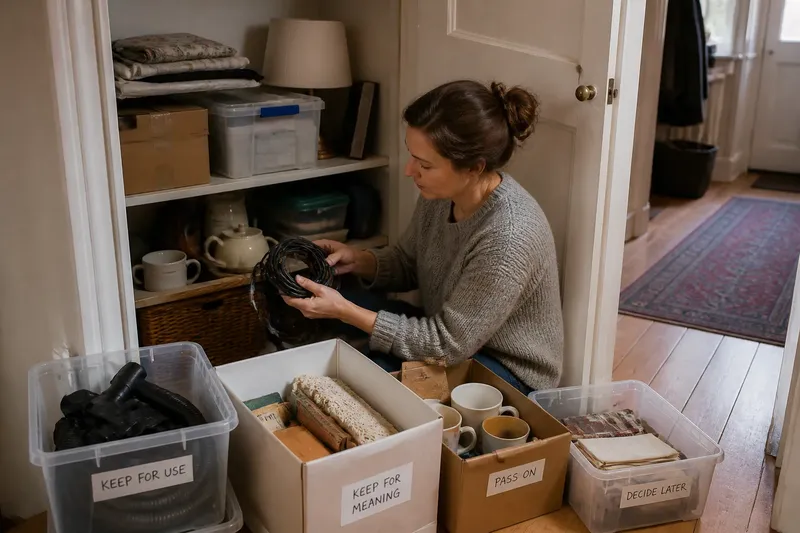
Mara takes one box at a time, checking the contents before assigning them a destination. She makes four working groups: keep for use, keep for meaning, pass on, and decide later. The last group is deliberately small. Without a boundary, “later” can become the cupboard’s permanent address.
- Keep for use: Does the object do a job she performs, or is it a sensible spare for an item she uses regularly?
- Keep for meaning: Does the object prompt a specific memory, mark a family connection, or matter to her in a way she can explain?
- Pass on: Is it clean, complete and useful to someone else, rather than merely difficult for her to discard?
- Decide later: Is there a genuine reason to wait, such as needing to ask a relative about a family item?
These questions keep sentiment separate from default retention. Mara does not have to prove that a keepsake is useful. Its meaning is a reason to keep it. But an object that is neither useful nor meaningful does not become valuable just because it has been stored carefully.
For the cables, she checks which devices they belong to and whether those devices are still in the household. A cable with a clear purpose can stay with the relevant device or in a labelled container. A loose cable that nobody can identify does not earn space by looking potentially useful. Mara avoids binning anything that may require a particular disposal route; she checks the relevant guidance before passing on or disposing of electronic items.
Storage needs a clear job
Once Mara has decided what to keep, she gives each retained group a suitable place. The vacuum attachments go together where she can retrieve them without unloading a shelf. The tablecloth stays folded with linens rather than being buried in a box of unrelated things. A small, clearly marked container holds the useful cables.
This is not a demand for matching containers or a beautifully arranged cupboard. The point is to make the contents understandable to the person who lives there. If Mara has to open several boxes to find one item, the storage arrangement is still asking too much of her.
She also checks that an object’s container is not taking more room than the object deserves. A bulky box kept for a few loose papers may be a poor fit; a slim folder could serve just as well. By contrast, a family quilt may need a proper protective space even if it is rarely used. The right decision depends on the object’s purpose and the care it needs.
Choose which memories to keep
The school papers make Mara pause. They are hers, but she has not opened them in years, and most do not bring a distinct memory to mind. She chooses a few pieces that carry a clear story and lets the rest go through an appropriate paper-recycling route. That choice does not erase her childhood; it gives the surviving keepsakes room to be noticed.
A useful distinction is between preserving a memory and preserving every object connected to it. A photograph, a handwritten note or one representative item may hold the meaning more clearly than a whole box of similar papers. Mara does not need to reduce every collection in this way. She simply asks whether the objects are adding separate meaning or repeating the same one.
Family belongings need a little more care. If Mara is unsure whether a relative expects an item to remain in the family, she asks before passing it on. That conversation is more useful than keeping an object indefinitely out of worry, or deciding in haste that nobody else cares about it.
What should you do when a decision feels difficult?
How can I tell whether I actually use an item?
Think about the task it serves and the last ordinary occasion when you reached for it. If you cannot name a likely use, consider whether it is a true backup, a keepsake or simply an unanswered decision.
Should I keep something because it might be useful someday?
“Someday” is more persuasive when the object has a clear purpose and fits a plausible need in your household. If the item is generic, replaceable or already duplicated, its imagined future use may not justify the space it occupies.
What if someone else in the household wants to keep it?
Ask what the object means or what job it does for them, then agree where it belongs and how much space is reasonable. A shared home works better when one person’s decision does not quietly erase another person’s attachment.
How should I handle things I cannot identify?
Look for a label, matching object or clear household use before deciding. If it may be part of an appliance, a family collection or something that needs special disposal, check with the relevant person or consult the manufacturer’s instructions where appropriate.
Let the cupboard show whether the decisions worked
After sorting, Mara leaves some space rather than filling every available corner again. The vacuum attachments are easy to reach, the linens are together, and the papers she chose to keep fit in a folder. She places the “decide later” items in one named box, not in several vague hiding places, and notes what question remains for each.
That is the result of her invented situation: not an empty cupboard, but one whose contents she can explain and use. The free space has a job too. It lets her put something away without shifting an unrelated pile, and it gives the cupboard room to cope with ordinary changes in the household.
If you are reviewing your own spare storage, begin with one shelf or one box and stop when you have made a set of clear decisions. Keep what serves a real task or carries meaning you value; make a specific plan for the rest. The spare-storage trap loosens when “I have room for it” stops being the only reason to keep it.