Open Shelves or Closed Cupboards for Everyday Objects?
Open shelves or closed cupboards? Choose storage for everyday objects by weighing visibility, access and visual busyness against how you use each item.
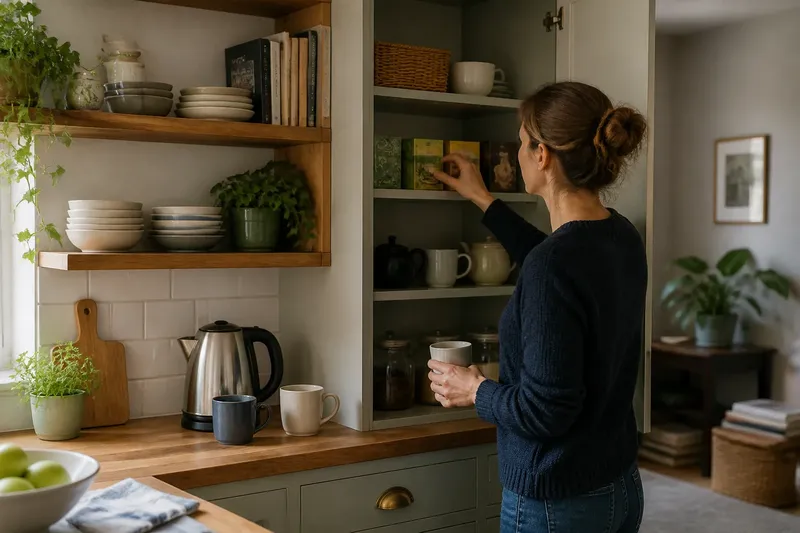
The common mistake with open shelves or closed cupboards is choosing by appearance before considering what the objects need to do. A lovely row of jars can become a daily nuisance if you reach for them with messy hands, while a cupboard can hide the mug you use every morning. Start with the objects and their routines, then decide what deserves to be seen.
Open shelves or closed cupboards start with the objects
For each group of everyday things, ask three questions: How often do you use them? Do you need to see them to remember they are there? Do they look calm together when they are out?
These questions help distinguish useful visibility from display. A bowl used at breakfast may earn an easy-to-reach shelf. Spare serving dishes, rarely used glasses or a jumble of mismatched packets may be better behind a door.
Make a quick list of the objects in the room, grouped by task rather than by material. In a kitchen, that might mean breakfast, making tea and preparing food. In a sitting room, it could be reading, mending and playing a board game. Keep the focus on what you reach for, not on creating a perfect inventory.
Match access to the daily routine
Open storage works well when a glance helps you choose and a clear reach makes a repeated task easier. Everyday plates near the dining table, a few frequently used cookbooks, or a basket of knitting beside a chair can be convenient in view. The arrangement should make sense at the moment of use, not merely look pleasing from across the room.
Closed cupboards suit objects that are used less often, are awkward to stack neatly, or interrupt the room’s visual quiet. They also keep small collections of unrelated things from appearing as one busy display. Think of a cupboard door as a simple lid on a box: the contents remain at hand, but no longer ask for attention whenever you enter.
Consider the full action, not just reaching. If an item must be lifted out from behind several others, an open shelf may not improve access. If opening a cupboard door blocks a narrow work area, a shelf or drawer elsewhere may be more convenient. The right choice depends on how the room is actually used.
Judge visibility and visual busyness together
Open shelves make the objects themselves part of the room. That can be welcome when a small group shares a colour, shape or purpose. It can also make a room feel restless when labels, odd leftovers and unrelated colours compete for attention. You do not need matching sets; a clear relationship between the items is often enough.
Closed storage offers a quieter surface, but it can conceal useful things so thoroughly that they are forgotten. If you choose cupboards for objects you use regularly, make their homes easy to remember. A clear shelf division or a simple label on the inside of a door can help without adding visual noise to the room.
Imagine you keep tea, mugs and a kettle on a kitchen counter, but the tea boxes make the corner look cluttered. You could leave the mugs visible, put the tea in a nearby cupboard, and keep the kettle where it is easiest to use. The expected result is a calmer-looking corner while the parts of the routine you handle repeatedly remain easy to reach.
Choose a storage style for each group?
Which everyday objects belong on open shelves?
Choose objects you use often and can return neatly without extra effort, such as a small stack of bowls or a few favourite books. Leave enough space to remove and replace them without shifting everything nearby.
What is better kept behind a cupboard door?
Put away items that are used occasionally, visually varied or difficult to keep orderly as a group. Cupboards are also useful for things you would rather not see while relaxing or working in the room.
Can open and closed storage share one room?
Yes. Many rooms work best with visible storage for a handful of frequently used objects and enclosed storage for the rest. Decide group by group rather than treating every object in the room alike.
How can I tell if an open shelf is too busy?
Look at the shelf from the doorway and notice whether one object or useful group is easy to pick out. If your eye keeps jumping between unrelated items, move some into a cupboard or give the remaining objects more separation.
Try the arrangement before making it permanent
Before buying shelving or changing a fitted cupboard, try the proposed arrangement with the storage already available. Place the likely shelf objects together on a table or an existing bookcase for a short while. Put the less visible group in a cupboard and check whether you can still find it readily.
Notice what you reach for, what you put back, and what you keep moving aside. If a shelf collects things that do not belong to its intended task, the grouping may be too broad. If you repeatedly open the same cupboard for one small item, bringing that item into view may make sense.
Where a storage decision depends on a product’s care instructions or the room’s fittings, follow the relevant manufacturer guidance and local requirements.
Let use, not display, make the final call
Open shelves or closed cupboards are not competing rules for a well-kept home. They are different ways to make everyday objects available and the room comfortable to look at. Keep visible what benefits from being seen and reached; enclose what works better out of sight.
After living with the arrangement, change only the group that is causing friction. A few objects moving from shelf to cupboard—or the other way round—can be enough to make a routine feel natural without turning storage into another household project.