The Side Table’s Journey from Utility to Accent
The side table’s history traces its shift from a handy surface beside a chair to a chosen room accent, while showing how practical use and display still meet.
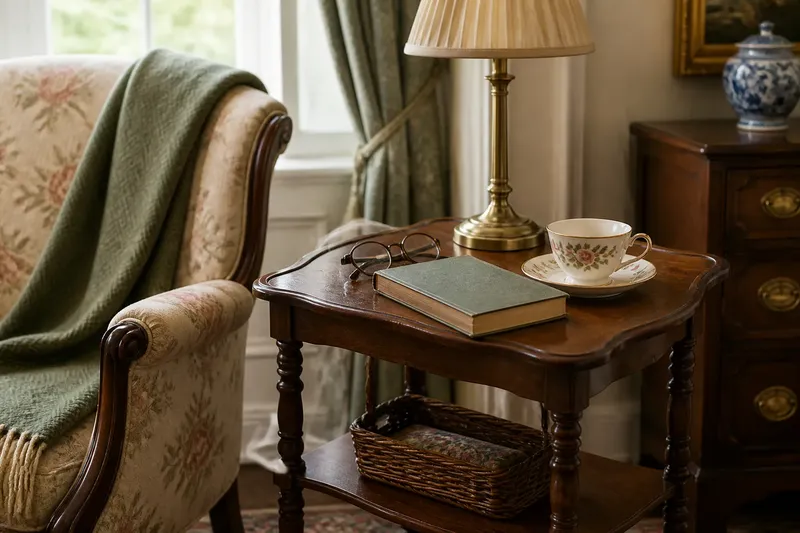
The common mistake in telling the side table’s history is to treat it as decoration from the beginning. Its place beside a chair makes more sense as a record of small domestic needs: somewhere to set a candle, reading matter or a cup within reach. Over time, the same useful surface could also help a room look composed.
Side tables served particular tasks in Georgian and Victorian rooms
In Georgian and Victorian Britain, a room’s use depended on household routines, the hour and the people gathered there. Parlours and drawing rooms could host visitors, conversation, reading and needlework. Furniture suited to one activity might be moved or used for another, rather than assigned permanently to a single task.
Small tables answered a straightforward problem. A person seated in a chair needed a nearby surface for a book, sewing, writing materials or a light. Different forms emerged for different purposes, including occasional tables and small stands. The names and designs varied; it is safer to think of them as part of a family of compact furniture than to assume every side table had the same origin or job.
A table beside a chair could make a task easier without claiming much floor space. A drawer might keep papers or small belongings out of sight; an open shelf could hold a basket. Those features were options, not universal rules. The object’s value lay in how well it served the household’s habits.
Side table history includes use and display
By the Georgian and Victorian periods, furniture in rooms used for receiving visitors could do practical and presentational work at once. A carefully arranged table might hold a lamp, vase or framed image, while remaining available for everyday use. This is a narrower claim than saying domestic display transformed all rooms: household customs differed, and furnishings depended on means, taste and the room’s purpose.
Placement could also shape what a table communicated. A pair of matching tables might support a balanced arrangement, while a single piece beside a chair could suggest a place for reading or conversation. In either case, the surface was not just a blank utility. It helped organise objects and make a room feel cared for.
Think of the table as a tray that has found a permanent place: it holds useful things, but its position and appearance also affect the room. That does not make function and decoration opposing ideas. A polished top can welcome a teacup as readily as an ornament.
Materials and forms reveal how households used side tables
Wood, veneer, painted finishes, stone and metal each offer different appearances and practical considerations. A wood surface can suit a warm, traditional arrangement; a painted finish can echo other colours in the room. These are design possibilities, not reliable clues to a table’s original use or a particular household’s history.
Shape gives more immediate clues about placement. A narrow rectangular top may sit close to a chair, while a round top can be approached from more than one direction. A drawer hides small items; a shelf keeps them visible. A nesting pair can be separated when extra surfaces are useful and brought together when they are not.
Look at the objects that gather nearby. If a lamp, spectacles and a book repeatedly compete for space, the table is serving a working role. If the surface is kept mostly clear and holds a single ornament, display may be the priority. Many pieces do both, depending on the household and the moment.
Choosing between practical use and visual emphasis?
What should a side table hold each day?
Notice which objects regularly need a place beside the chair, such as a book, glasses or cup. If a lamp is part of the arrangement, make sure its base sits securely and leaves usable space for other items.
Does a side table have to match the chair?
No. It can relate through colour, material or scale without being an exact match. A contrasting table can make the corner more distinctive, while a close match can create a quieter arrangement.
Should a side table have a drawer or shelf?
Choose a drawer if small belongings are better kept out of sight. Choose an open shelf if a basket or book should remain easy to reach; a plain table suits a household that wants little stored there.
Can an accent table still be practical?
Yes. A table chosen for its shape or finish can still hold a cup or reading matter. The useful question is whether its everyday role fits the way the household actually uses the room.
A worked example shows how utility and decoration can meet
Say a household has a reading chair beside a window, a paperback and spectacles that usually end up on the floor, and a small lamp that needs a stable place. They choose a narrow wooden table with a flat top and no drawer, then place the lamp at the back and leave the front clear for the book and glasses. The resulting arrangement gives those items a reachable home while the wood relates to the chair; the trade-off is that loose belongings remain visible because there is no concealed storage.
This kind of choice connects the side table’s history to its continuing household role without pretending that every period or home used furniture in the same way. The side table remains a useful object because it brings a surface close to the person who needs it. Its appearance can add meaning, but the most convincing accent often begins with noticing what the chair’s occupant actually reaches for.